The Ghost of the Bellevue Shaft
Historical Account
This story documents local folklore and should not be interpreted as a verified historical account.
From the Pennsylvania archives
In 1872, deep beneath Pennsylvania's anthracite country, miners at the Bellevue Shaft near Scranton began reporting something they could not explain.
The city above them was already a coal capital. Breakers rose over the Lackawanna Valley. Rail lines hauled black cargo toward the river and the coast. Below street and slope, the work was older and narrower: timbered headings, wet stone, the smell of coal dust, and the thin reach of a lamp. A man could know his own gang and still feel, a few turns of the passage later, that the rest of the world had been sealed off.
According to the contemporary account attributed to the Scranton Republican, that isolation did not stay empty.
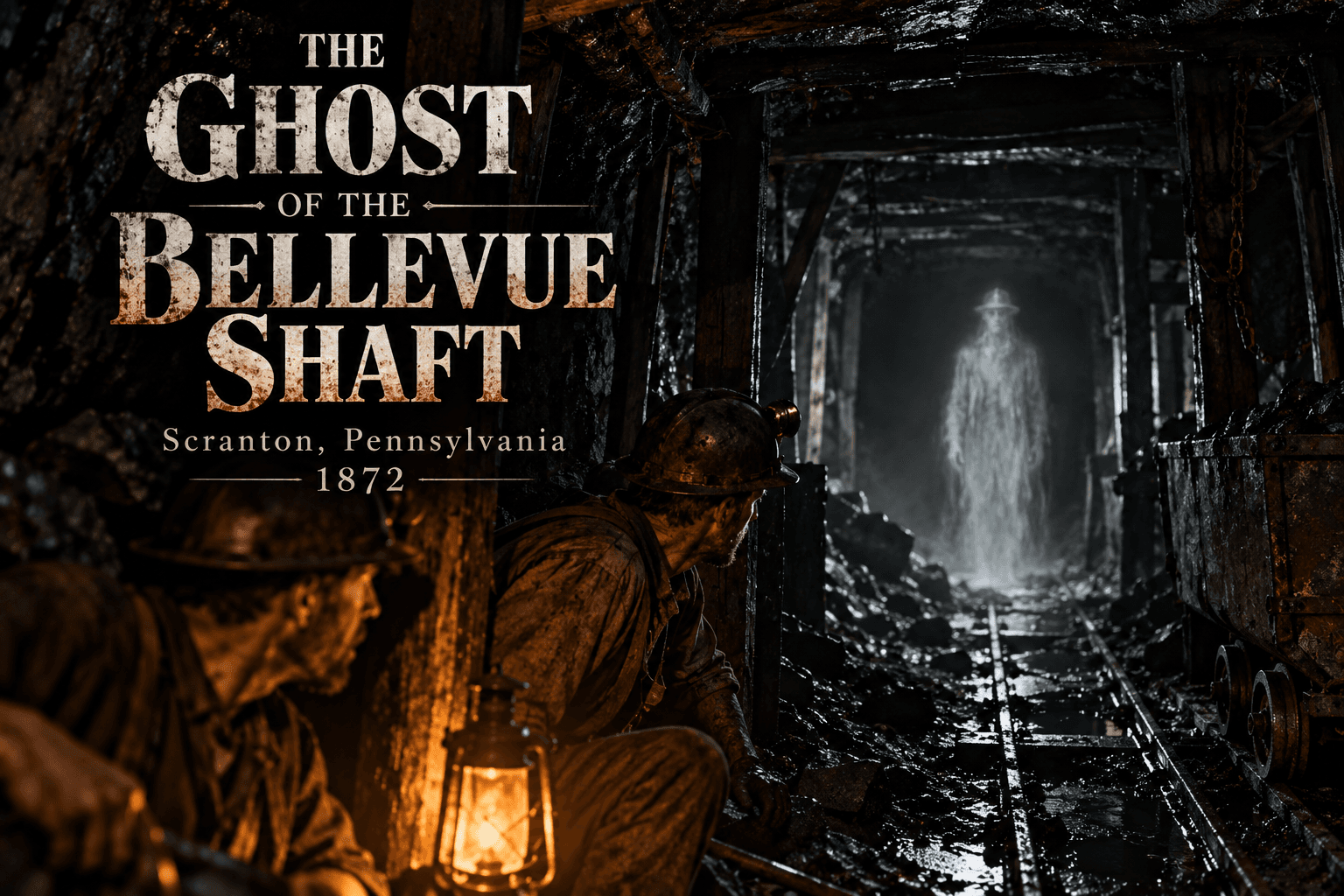
The newspaper described a figure seen underground at the Bellevue Shaft — tall, white, and vapor-like, more mist than flesh. The story claimed it moved through the workings where miners expected only themselves, their tools, and the animals that hauled coal in the dark. No name was attached to the apparition in the version of the report that has come down to later readers. It was not presented as a known dead man returning to a familiar room. It was presented as a presence.
Miners reportedly refused to treat it as a trick of the lamp. The account said the sightings frightened the men who worked the shaft and the mine animals that shared those passages with them. In a place where a sudden bolt could mean a wrecked car or a crushed foot, fear in a mule was not a parlor tale. It was a practical danger.
The newspaper also described attempts to shoot at the figure. That detail, as the 1872 account has been remembered, is part of the legend's hardness. Men who spent their days under timber and slate were not, in the story as told, content to whisper. They tried to put a bullet through whatever stood in the heading. The contemporary account, as it has been remembered, did not claim the shots settled the matter.
Walnutport Review does not have the complete 1872 article in hand. We will not invent the missing sentences. We will not put words in a miner's mouth, name a man who is not in the source, or assign a depth, a date within the year, or a death the report does not give us. What can be said with care is smaller than a ghost story usually wants to be, and that is the point.
Scranton in 1872 was real. The Bellevue Shaft was a working anthracite operation in that city. The Scranton Republican was a newspaper of the region. And the story that attached itself to that shaft — a tall white figure in the mine, frightened men and animals, shots fired into the dark — entered the state's store of coal-country legend.
Read it as it was offered then: a report of what miners said they saw, printed in a year when the anthracite fields were already thick with accident, rumor, and night work. Whether the heading held only dust and lamp-smoke, or something that would not take a bullet, the paper did not prove. It only told what was claimed below Scranton, in the dark of 1872.
Anthracite work in those years was already a geography of rumor. Men carried news from one slope to the next the way they carried lamps: a little light, a long shadow. A story printed in Scranton did not have to be proven in a courtroom to travel. It only had to sound like the dark the readers already knew.
The passages are still easy to imagine. Props sweating. A lamp that makes a circle and leaves the rest. Coal underfoot. A long way back to air. In that kind of dark, a pale shape does not need a biography. It only needs room to stand.
What the Republican offered, as the legend remembers it, was not a solved case. It was a notice from below: something white, something tall, something that would not stay put when men tried to end it with a shot. The rest is the mine itself — timber, coal, isolation — and the fact that Pennsylvania has never been short of places where a lamp fails to reach.
The archive keeps the report. It does not close the shaft.
Based on an 1872 account attributed to the Scranton Republican. The newspaper report, if accurately preserved, is public-domain historical material. Walnutport Review does not possess a complete contemporary transcription of the original article. This page is a modern retelling of the reported legend, not a reprint of the 1872 text.