No Footprints In The Snow
Fiction
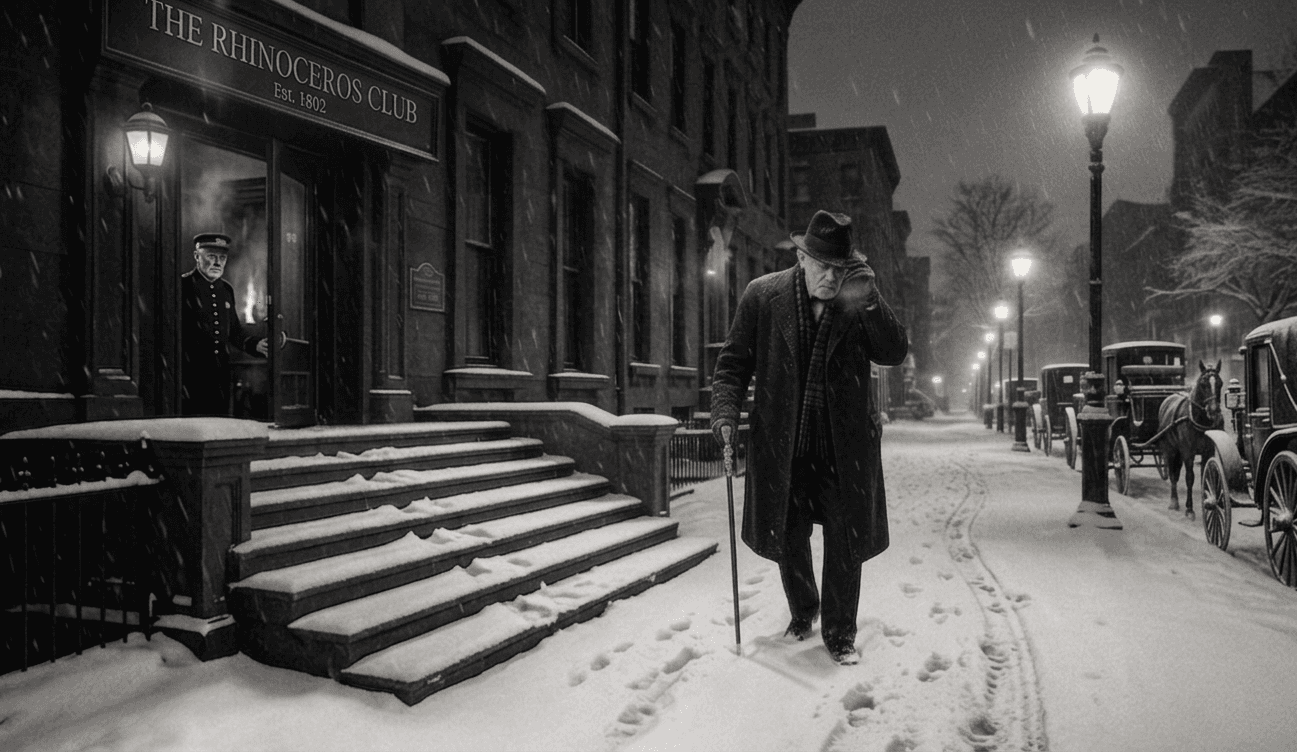
Hawthorn stepped out of the warmth of the club into the snowy night. The faint aromas of woodsmoke and oaken walls clung to his clothing, the tang of pipe tobacco swirling around him. He tugged the brim of his hat a bit lower over his eyes and tapped the ground twice with the tip of his cane.
The group was called The Rhinoceros’ Horn, for reasons that no one could recall. They met every Thursday at the club and had done so since time forgotten. The building was well over a century old, and the Horn had always been there. An old, solid brownstone with eight low steps to the front door. Inside the door stood Robertson, a study in age himself.
The snow had been falling for over an hour as Hawthorn began his walk home. The whiteness blanketed everything, crowns of it on the tops of streetlamps, shoe-tops deep everywhere. Parked carriages showed as white lumps along the curbs. No one was out in the weather.
Hawthorn stepped cautiously. The snow was powdery and very light, spraying out in front of him as he walked. At his age, he realized he needed to be careful. A slip could leave him stranded on the sidewalk, soon to be covered in just another lump in the snow. Bones naturally became more brittle as men aged, and the last thing he needed was something broken.
In the club, the warmth was pervasive. Thick imported rugs seemed to gather and store heat in them, and the three fireplaces were all lit beginning at the end of September each year. The men sat in plush wingback chairs arranged in loose semicircles in the different rooms, overhung by rafts of pipe and cigar smoke and by portraits of past members of the Horn. Robertson, perfectly unobtrusive, lingered in the shadows, always ready to bring fresh drinks.
Hawthorn’s house was a six-block walk from the club. He and Wanda had lived there for thirty years until her passing four years earlier. Rather than rattle around his rooms alone, he became more active in the Horn. The group had no real activities aside from the Thursday gatherings, but on any given evening, there were at least a few men talking and laughing in the club.
Four to five nights most weeks, Hawthorn shuffled the six blocks to the club. Robertson opened the door as he approached, took his hat and coat, and gestured him to the others. Greeted by raised drinks and general mirth, he would take his seat, light his pipe, and sip at the drink that he never noticed arriving.
On the snowy evening, Hawthorn sat near one of the fireplaces beside Grover, the longest-standing member of the Horn, as well as Raskin, Porter, and Stedman. Others came and went between the rooms.
“It’s horrible, these murders,” Stedman was saying as Hawthorn took his seat. “Seven girls now. The police are confounded. They don’t know where to start.”
“The Brownsville Ripper, they’re calling him,” Raskin offered. “The editor at the Bee is struggling mightily to prevent that name from being printed, but it’s just a matter of time, I suppose.”
A general murmur rose from the fireside.
The Brownsville Ripper, a nickname Hawthorn hadn’t heard previously, had been lurking in the shadows of the city over the previous three months. The Ripper name was no doubt inspired by London’s Jack, slashing his way through Whitechapel some thirteen years before. The turn of the century brought optimism for a more enlightened, genteel age, but some men refused to evolve.
Every murder was discussed at length at the Horn. Heavy copies of the Brownsville Bee ruffled and folded as men harrumphed with every new victim. Extra editions appeared, and the newsboy from the corner always made sure to deliver several copies to Robertson.
The snow bunched on Hawthorn’s shoulder as he made his way cautiously along. He paused under a streetlamp in the silence to brush it off and was almost knocked off his feet. A girl nearly collided with him on the sidewalk, and he leaned more weight on his cane to avoid her.
“Watch where you’re going, girl!” Hawthorn exclaimed, annoyed. He had been enjoying the quiet and isolation of the walk, if not the weather, and the near miss startled him. He turned and looked at the girl, young, with reddishly dark hair falling about her shoulders in loose curls. She wasn’t wearing a coat, but only a long dress, cream-colored, falling nearly to her ankles. Her face was pretty, but her eyes were wild.
“Apologies,” the girl said. Her hands, slightly blue in the cold, were crossed over her midsection. “Apologies.”
“Mind your step. You nearly knocked an old man down.”
“Apologies.” She dipped her head and made to turn to leave.
“Why are you out in the snow like that?” Hawthorn asked. “Aren’t you cold, girl?” She kept her head low, the curls hanging, and did not answer.
In the club over the last few months, at the time of the Ripper, everyone had a theory about who was committing the murders. Savage, bestial killings that could not have been committed by a sane man. Porter thought that, since the Ripper had not been caught or even seen, the killings were done by a policeman. Someone who would know where and when he would remain undiscovered. Grover had nodded thoughtfully, a thick cloud of pipe smoke ringing his head. Bernstein, one of the junior members of the Horn, theorized that supernatural forces were at work. He suggested with a serious tone that the Ripper could be a werewolf or something similar. Grover and the rest of the men laughed, and Bernstein flushed with embarrassment. He stood and left the room.
“Robertson,” Grover had called. The man emerged from seemingly nowhere beside the comfortable wing-back chair, hands folded neatly behind his back. “What is your theory? Who do you think is behind these crimes?”
“I wouldn’t care to speculate,” he said flatly. “May I bring you a drink, sir?”
“Oh, come now, Robertson, you receive the papers,” Stedman said. “You know the details as well as we do. You listen to us go on at length, daily. You must have a thought to spare.”
“I am but a servant, sirs,” Robertson replied calmly. “I’m not an investigator. I prefer to leave the police work for the police.” A terse smile, and Robertson was gone.
“Apologies,” the girl repeated.
“Are you lost? Why would you be out here like this?” She did not answer. Hawthorn was puzzled by her reticence. “May I escort you? This is no time for a lady to be out in the elements alone. There’s a madman on the loose, you know.” At these words, she quivered. Hawthorn softly reached out a gloved hand to reassure her, but she backed away. “It’s not me, I can tell you that. Let me take you to your destination. Where are you going?”
She glanced up, and he saw tears in her eyes. What possessed the disturbed girl to be out alone, late at night, undressed for the snow amidst a plague of murder, he couldn’t guess.
“Please, at least take my coat,” he said. “You’ll freeze.” He began to unbutton his overcoat, his scarf loosening at his throat, and the girl backed away another step, holding her hands up defensively. “All right, all right. Let’s get you to somewhere safe.”
The woman walked a half-step ahead of Hawthorn in the snowy night. There was still only silence, that quiet that snow brings, around the pair on all sides. The snow fell endlessly, piling up on the sidewalks, and Hawthorn felt the cuffs of his pant legs beginning to dampen.
“Where are you going, girl?” he asked. “Would you tell me your name?” She remained silent, barely glancing over her shoulder at Hawthorn. She walked assuredly enough, turning onto a smaller side street. Few house lights dotted the scene, seemingly far fewer than one would expect. Hawthorn tugged at his coat, pulling it tighter around his neck. He quickened his pace, but the strange girl stayed slightly ahead of him, leaving him consistently just behind.
Hawthorn’s breath and his footsteps schussing through the powdery snow were the only sounds. Preternaturally silent, the quiet that only comes with fresh snow, he observed that they were leaving the busier- yet still empty- streets and heading to smaller side roads and alleyways.
“Do you know where you’re going?” he asked her.
“Apologies,” is all she said. She did not turn when she spoke.
“You know who I think it is,” intoned Jennings, the second-most senior member of the Horn. His face was lit yellow and orange in the flickering firelight. “Some completely random person. When they finally catch this monster and hold him up to the light, he won’t know any of the victims. He’s probably a drifter, passing through town, who got a taste for killing while he was here. So, he stayed.”
“None of the victims is related. The police have ruled out family members, spouses, those sorts,” said Leonard. He held a tumbler of bourbon before his mouth as he spoke. “It’s certain to be an unknown entity.”
“The Ripper could be anyone,” Grover said, calmly and coolly. “Even one of the Horn, for all we know. Until he’s caught, any thoughts would be just speculation. Pointless. Libelous, perhaps.”
“They’ve had interviews with every patient at the Alienist’s Hospital,” Leonard continued. “No one was unaccounted for at the time the murders were committed. There are over forty men receiving treatment there who are allowed day passes to leave the hospital grounds. None of them could be the Ripper.”
On the snow-whitened side street, there was only one light in a shaded window. The moon was swathed in silver cloud, and the snowy ground reflected ambient light. It glowed strangely bright in the night. Hawthorn marveled at the speed the girl effortlessly maintained and struggled to keep up.
“Slow down, girl,” he said to her as he struggled along. “I’m trying to see you safely home. Please allow me.”
“Apologies.”
“Where in the world are you taking me?” he asked to no reply. The girl turned down another, still smaller street as Hawthorn hurried along behind. The snow, heavy flakes, showed no sign of slowing, and neither did the mysterious girl.
She looked so much like some of the photos he’d seen- they’d all seen- in the Bee. The victims of the Ripper. Twenty-something, young, conventionally attractive. Long dark hair. He’d seen similar faces on the seven dead girls. That was one reason he was so insistent on escorting her, for her own protection. On a night like tonight, Hawthorn reasoned, with so few people out, the madman would likely be prowling.
“No theory can be stranger than it being a werewolf,” Stedman had said earlier in the evening with a snicker. Bernstein’s idea.
“Preposterous,” Porter huffed dryly. “Just silliness. Besides, so far as I know, none of the murders have happened under a full moon.”
“Ladies should be carrying silver with them,” added Jennings with a laugh. “Garlic necklaces, and so on.”
“Garlic wards off vampires, not werewolves,” Hawthorn had said.
“My Ellen cooks so poorly, and with so much garlic, it would keep either creature away from our kitchen,” snickered Raskin. They all laughed.
“It is strange, if you really think about it, though,” Hawthorn said. He leaned forward in his chair, feeling the warmth of the fire on his cheeks. He felt himself redden. “It’s very strange that in all of these murders, no one has been caught. There hasn’t even been an eyewitness, and there are seven women killed.”
“Each murder has been under the cover of the night,” said Porter.
“But in the downtown area,” Hawthorn protested. “There are electric streetlamps, and the killings have all been in well-populated areas. Someone should have heard something by now, a scream, perhaps, or seen a mysterious figure stealing away in the darkness.”
“Listen to you,” laughed Stedman, who elbowed Raskin in the next seat. “You and Bernstein, cut from the same cloth!”
“I’m not saying there’s a monster afoot. Not a literal, hairy, snarling creature of the night. But Bernstein saw it as strange that this murderer had remained completely undetected to this point. It’s strange.”
“It’s not the same as a werewolf, Hawthorn,” Stedman continued. His belly shook with mirth. He found the idea tremendously amusing.
“I’m not suggesting something supernatural.”
“But you don’t feel that can be ruled out,” Porter said.
“You can never rule something like that out one hundred percent,” Hawthorn said, a defensive edge creeping into his tone. “We simply don’t understand enough of the world around us to dismiss anything we cannot grasp. Not long ago, the internal combustion engine would have seemed like magic. Besides, I don’t think we’re dealing with a werewolf here, for God’s sake.”
“Well then, what do you suggest?” Raskin asked.
“I don’t know. I don’t purport to know. I’m just saying we can’t rule anything out.” He folded his arms across his chest.
The girl turned another corner. Hawthorn realized it was little more than an alleyway.
“Stop, stop,” he called to her. “Wait- miss, you must tell me where you’re going! This part of town is unsafe!”
Without acknowledging him, she glided into the narrow alley, lined on one side with wooden crates stacked haphazardly and tin trash cans unevenly arranged.
“Miss, there must be another way we can go,” Hawthorn said. Suddenly, the girl stopped, and Hawthorn nearly returned the favor of bumping into her. “Please—”
“Apologies.”
“You sound crazy,” Jennings said by the fire. “Do you hear yourself?”
“I’m only saying that we can’t rule anything out!” Hawthorn said angrily. “Until the mystery of the Ripper is solved, it’s a fool’s errand to assume we know anything. We all assume this killer is a man; should we completely rule out a woman as the perpetrator?”
“Hawthorn, you’re speaking foolishly,” came the calm voice of Grover. “When Bernstein proposed such an idea, we were not surprised. But I think we all expected better of you.”
The remark cut Hawthorn deeply. He’d known Grover for years, as long as he’d been associated with the Horn, and felt a deep friendship and respect for him. Grover was not a man to make off-handed comments, and his opinion carried great weight with all the other members. Hearing his friend speak like that, calling him a fool, hurt him deeply. He stood, tucking his pipe away.
In the alley, Hawthorn looked past the girl. To the right, from behind a loose row of trash cans, a foot was sticking out. Unnoticed, a thin shoe lay mostly buried near it, speckled with blood. Crimson spots trailed from it back to the body. Hawthorn’s breath caught in his chest. He inched closer, seeing more of the body half-hidden by the cans. He realized it was the butchered body of a woman.
The eighth victim of the Ripper.
Robertson met Hawthorn in the foyer. He was already holding the man’s jacket and hat.
“Retiring for the evening, Mr. Hawthorn?” he asked as he held the coat up and took the member’s cane. Hawthorn frowned as he shrugged into it. “It’s snowing rather heavily out. Please be careful.”
“Thank you, Robertson.” Hawthorn took back his cane and set his hat atop his head.
“Would you appreciate assistance getting down the stairs, sir?”
“No, thank you. Have a good evening, Robertson.”
“Will we be seeing you tomorrow evening?” the servant asked as he opened the door. A curl of frigid air blustered in from the street.
“We’ll see,” Hawthorn said and left.
“Run, woman,” Hawthorn exclaimed in the alley. “Scream! Something! We need a policeman!” He leaned down, holding his cane tightly, and made his way around the cans. “Run,” he said again and fell silent.
The dead woman on the ground had been deeply sliced and was heavily covered in blood. Her cream-colored dress was stained nearly black across her torso, the same shockingly red blood vibrant against her pale skin. Snow had fallen and speckled her dark, reddish hair.
“My God,” Hawthorn gasped, realizing who he was looking at. He whirled around, and the girl he’d followed into the alley was gone. He looked back at the body, and it was the same. Painfully, he rose from his crouch and looked back down the alley, although he knew what he would see.
Other than his own, there were no footprints in the snow.
Although the girl was no longer with him, there was no sign that she had fled, nor that she had ever stood beside him at all. He had asked the girl to scream, and when she could not, he did, falling to his knees beside the body.
“Tragedy,” he muttered to himself, a tear growing cold on his eyelash. “The very bloom of life.”
Ahead of him, in the shadows of the bins and the anonymous brick façade and past the head of the eighth victim, something moved. Hawthorn snapped his eyes up into the darkness. Rat? Alley cat? His vision adjusting, he saw the whites of eyes soft in the black. Human eyes.
A face leaned slowly into the meager alleyway light, a long and cruel chin, a pointed nose, and a tombstone smile. The eyes deeply sunk and remaining in shadow, Hawthorn also saw another gleam, that of the silver menace of the blade the man slowly drew.
“Nice evening for a stroll,” the man said slowly, his voice low and sibilant. Hawthorn’s heart felt as if it were near to burst in his chest. The blade emerged fully from its sheath, and the Ripper moved towards Hawthorn, and he heard a more familiar voice. From behind him, the voice of the disappeared girl, as if her body spoke rather than her specter.
“Apologies,” she said, as the Ripper fell upon him.
Quarterly Fiction Prize winner, originally published on Walnutport Review, May 2026.