Fishing
Fiction
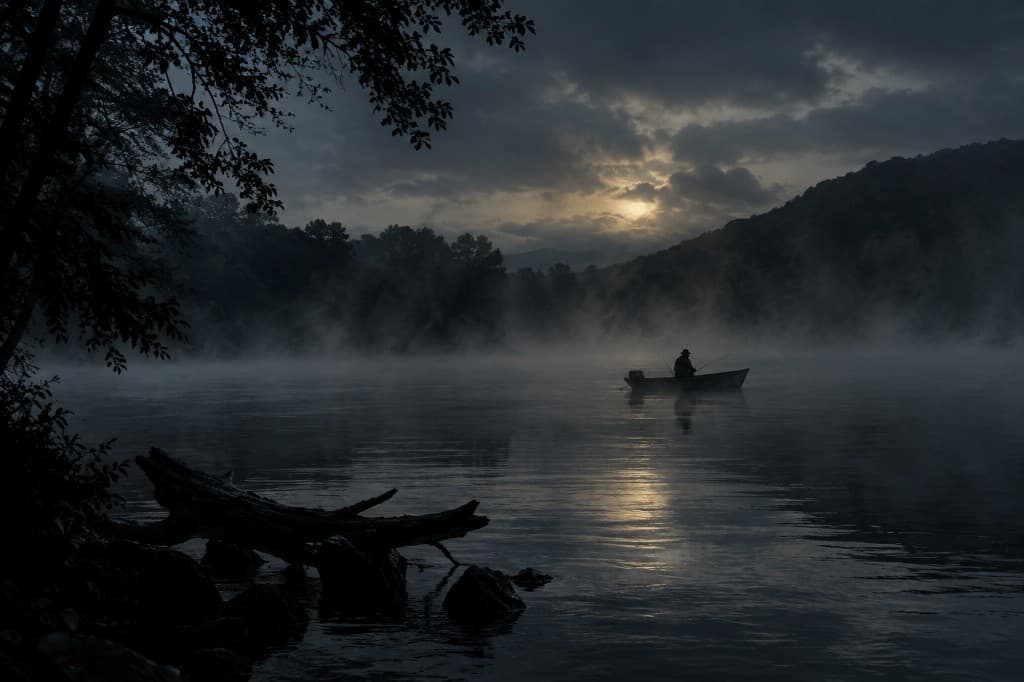
4:00 AM, Scott's list of miseries, but the Susquehanna changed all that. The early gloom didn't hold the same dread it did during the week. Bright and restless, he moved through the pre-dawn ritual. Gear stood staged and ready in the garage. The new ice maker had churned out a full, frosted bag overnight. A Jersey Mike's Italian sat in the cooler alongside sweating bottles of Gatorade. The forecast promised a punishing heat, the kind that turned the river into torture by noon. Success required beating the sun to the water.
He climbed into the truck, hitched to a custom-welded hull. The builder produced only a handful of these a year. Beasts of thick aluminum armored with a half inch of ultra-high-density plastic along the belly. It was a necessity for the Susquehanna, a schizophrenic run of water that could drop from fifteen feet to six inches without warning. On plane, the boat was a unstoppable, skimming jagged rock ledges that lurked just inches below the deck. It was designed to fly over the shallows, provided the pilot never faltered; to lose momentum at that depth was to be cooked. Three tackle boxes, life vests, and a locker bristling with ten rods were already secured. He eased from the driveway, ghosting out of the cul-de-sac with just enough throttle to vanish before the neighbors could stir.
The two-hour haul remained a monotonous blur, fueled by the desperate anticipation of shedding a week's worth of buying and selling. He broke the drive at a Wawa, the fluorescent hum of the store highlighting a familiar, nagging heaviness in his chest. It wasn't the scratch of a common cold; it was a rhythmic, liquid presence settled at the base of his lungs. He grabbed a handful of cough drops as a temporary truce with his body, then stepped back into the humid air to top off the tank. Another hour of blacktop stood between him and the silence of the river. That was the draw: the eradication of talk. No forced pleasantries, no empty social noise, just the solitary exchange between a man and the water. Out there, even a torrential downpour felt like a gift.
The launch was a matter of muscle memory, the trailer sliding into the Susquehanna with practiced precision. But as he worked, the irritation in his chest sharpened; every five minutes, a fresh wave of thick, translucent fluid surged into his throat. He cursed the seasonal allergies and the mounting cost of a doctor's visit he couldn't afford, yet there was an odd, heavy rhythm to the congestion that cough drops couldn't touch. He focused instead on the ritual: drain plug secured, a mistake he'd nearly paid for in ankle-deep water once before, and all gear accounted for. Then he was off. He hammered the throttle, the hull lifting with a roar as the front end cleared the surface, settling into a perfect plane within five seconds.
Solitude was the ultimate prize; with no other boats on the water, his favorite spots remained undisturbed. Scott had little patience for the weekenders who crowded the banks later in the day. Men who bought the expensive reels and mastered the lingo but lacked the instinct to pull a single strike. He'd heard their litany of excuses for years: pressure fronts, winter kills, or the moon phase. But Scott always found them. Under his hands, the river yielded scores of fish where others found only empty water.
He owed that precision to Anderson, an old guide who had spent thirty years mapping these currents. Anderson used to joke that he had the fish trained to a weekly schedule, but the truth was simpler: he understood the river's geography. "Think of it like a homestead," he'd told Scott. "A man owns a hundred and fifty acres, but he only eats, sleeps, and lives in a few small rooms. If you're floating above that land looking to catch him, you don't cast blindly into the woods. You find the house. You know he loves Italian sandwiches, so you bounce that sandwich right off his front porch. Sooner or later, he's coming out to grab it."
The logic was inescapable. Scott followed Anderson's advice, stalking the "rooms" of the river while maintaining the distance of a sportsman. He never kept what he caught; he had no stomach for the taste of the river. But today, the river was aggressive. On his third cast, a smallmouth bass hammered the lure, a three-pound slab of muscle forged by the relentless current. It fought with a frantic, panicked strength until Scott finally scooped it into the net. As he lipped the fish to steady it, the creature let out a wet, guttural burp that vibrated against his thumb. He froze; certain the sound was the word Why? He turned the bass in the light, and its eyes didn't just bulge; they tracked his movement with a terrifying, lucid intelligence.
He released it, but the day had shifted. The heat became a physical weight, soaking his hat and pressing against his temples. Worse was the cough. His throat had moved past soreness into a raw, parched agony that no amount of water could soothe. By eleven, the ninety-degree air felt like a solid wall. He drank until his stomach was full, but the thirst remained, a deep craving that reached all the way down to the liquid settled in his lungs.
The launch was only thirty minutes away, but the distance felt eternal. The heat had become a predator, starving him of oxygen. Every breath was a struggle against a chest that felt increasingly hollow, while his skin tightened into a dry, abrasive husk. He collapsed onto the bench, the memories of a clean physical and a healthy lifestyle feeling like artifacts of a stranger's life. This wasn't illness; it was a demand. He stripped away his clothes—his last tether to the dry world—and slipped over the side.
The Susquehanna didn't just cool him; it claimed him. The water rushed over his skin with the relief of a long-denied thirst. When he slipped, losing his grip on the aluminum hull, the panic was brief. He went under, gasping instinctively, and the river rushed in to fill the void. It burned like liquid fire, scouring his throat and purging the weeks of stagnant congestion in one violent, cleansing exhale. He drew the river deep into his lungs again, but this time, there was no struggle. Only the ease of a mechanism finally clicking into place. His skin, once parched, now felt reinforced, hardening into an abrasive, protective armor.
He turned in the current to see a silent congregation: dozens of smallmouth bass, their eyes wide and knowing, waiting in the shadows. They beckoned with a rhythmic flick of their tails that he suddenly understood. He surfaced once more, watching the custom boat, a hollow monument to his old life, drift aimlessly away. There was no sadness in the parting, only the quiet recognition of a homecoming. He turned back to the depths, following the creatures who understood him better than he had ever understood himself.